
The short version
ADHD shame and ADHD guilt are not the same feeling, and they don’t respond to the same fix. Guilt says you did something wrong. Shame says you are something wrong, and that distinction matters clinically, not just semantically. Guilt can be resolved by changing behavior. Shame can’t, because it isn’t about behavior. It’s about self-concept, and self-concept is language-based, which is why the fix has to start there too. Left alone, shame doesn’t just sit there either. It raises stress hormones and makes the exact executive function skills you need, memory, planning, follow-through, harder to access, which means it feeds the next round of evidence against you.
Why does ADHD cause so much shame?
Because every dropped ball gets misfiled. For a lot of people, a missed deadline is a missed deadline. For an ADHD brain, a missed deadline becomes evidence. Not “I was juggling too much this week.” Evidence that you are fundamentally lacking, the kind of person who can’t be trusted, again.

That’s not an accident of personality. It’s a pattern researchers have actually documented. A qualitative study on adult ADHD found that most participants said the standard diagnostic criteria didn’t capture what they were actually living with, and roughly three out of four reported struggling specifically with rejection sensitive dysphoria, an intense, often disproportionate emotional reaction to perceived criticism or failure. Every system collapse becomes proof of personal inadequacy instead of a situational misfire. That reclassification, misfire into character flaw, is where the shame actually gets built.
What's the real difference between ADHD guilt and ADHD shame?
Guilt is behavior-referential.
It says, I made a mistake.
Shame is self-referential.
It says, I am the mistake.
That difference sounds academic until you watch what happens next. Guilt gives you somewhere to go: apologize, fix it, do it differently next time. Shame doesn’t, because there’s no behavior to change when the problem was never framed as behavior in the first place. It was framed as you.
ADHD psychiatrist Edward Hallowell has described shame as one of the most debilitating parts of having ADHD, more damaging in some ways than the symptoms themselves, because it keeps people from recognizing what they’re actually capable of. That tracks with what I saw for years in cognitive rehab, working with adults relearning attention, memory, and organization after brain injury. The clinical work was never just teaching a strategy. It was untangling what someone had started believing about themselves because the strategy hadn’t worked yet.
Why doesn't trying harder fix ADHD shame?
Because trying harder is a behavior-change strategy, and shame isn’t a behavior problem.
You can’t out-effort a belief about who you are. If anything, effort without a shift in the underlying self-concept just gives shame more material to work with. You try harder, the system still falls apart because the system was never built for how your brain actually works, and now you have a new piece of evidence: I tried my hardest and it still didn’t work, so it really must be me.
This is the part most advice misses. It treats shame like a motivation problem and hands you another tool. But the tool was never the missing piece. The story running underneath the tool is.
Does shame actually make ADHD symptoms worse?
Yes, and this is the part that turns it into a loop instead of a one-time sting. Shame is not a neutral emotion sitting quietly in the background. It raises cortisol and other stress hormones, and elevated stress hormones measurably interfere with memory and executive function, the same systems already carrying the load in an ADHD brain.

So the sequence looks like this. A task falls through the cracks. Shame shows up and reads it as a verdict. The stress response that shame triggers makes it harder to plan, focus, and follow through on the next task. That next task is more likely to fall through the cracks too, which hands shame more material. It isn’t a metaphor to say shame makes ADHD harder to manage. It’s a documented physiological loop, and it means the shame itself has become part of what you’re trying to work around, not just a feeling that shows up after the fact.
This is also why generic advice to “be kinder to yourself” often falls flat. It’s aimed at the feeling, not the loop. Interrupting the loop means catching the moment shame turns a situational misfire into a character verdict, before the stress response has a chance to compound it.
What does self-talk have to do with fixing ADHD shame?
Self-talk is the mechanism, not a soft add-on to the real work.
As a speech-language pathologist, I spent years treating self-talk as a functional, testable part of cognition, the same way you’d treat memory or attention. It’s part of how the brain plans, sequences, and follows through. So when the sentence running in the background after a missed deadline is some version of “of course you failed, you always do,” that sentence isn’t just unpleasant. It’s actively shaping what happens the next time you try to start something.
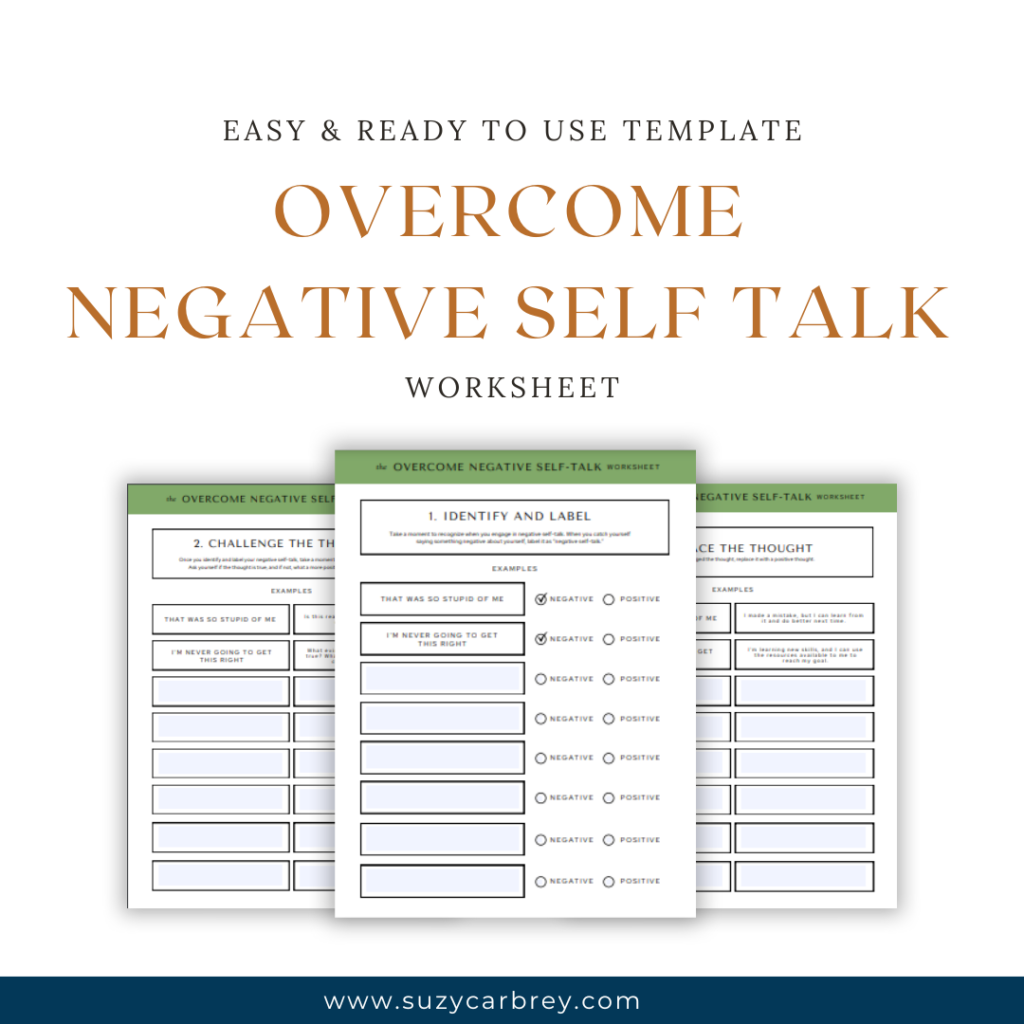
Changing that sentence is a real intervention, the same category as changing a system or building a new routine. Reconstructing the self-concept has to happen at the language level, because that’s the level the shame was built on in the first place.
I’ve watched this play out with clients in a very ordinary way. Someone misses a deadline, and the sentence that shows up is “I always ruin things.” We don’t start by fixing the deadline. We start by asking where that exact sentence came from and whether it’s actually true, or just familiar. Familiar and true are not the same thing, and shame depends on the two getting confused.
The bottom line
ADHD shame and ADHD guilt run on different tracks, and only one of them responds to effort. Guilt says you made a mistake and can be resolved by changing the behavior. Shame says you are the mistake, and left unaddressed it raises your stress response enough to make the next mistake more likely, not less. It only loosens its grip when you change the sentence you’re telling yourself about what happened, not the amount of effort you’re throwing at the next attempt.
Try this
Next time a system falls apart, write down the exact sentence your brain says about it. Then ask yourself one question: if a friend told you this happened to them, would you conclude they were failing, or having a hard week? Notice the gap between those two answers. You don’t have to fix the sentence yet. Just start catching it.
A few common questions
Is ADHD shame different from regular shame?
The emotion itself works the same way shame always does, but the trigger is more frequent and often invisible to other people. A missed deadline, a forgotten appointment, or a disorganized desk becomes a private verdict on character, several times a week, in ways that rarely show up to anyone watching from the outside.
Why can’t I just think my way out of ADHD shame?
Because thinking your way out usually means trying harder or being more disciplined, and shame isn’t responding to discipline. It’s responding to the story you’ve built about what your struggles mean about you. That story has to change before the discipline has anywhere useful to land.
Is rejection sensitive dysphoria the same thing as ADHD shame?
They’re related but not identical. RSD is the acute emotional reaction to perceived criticism or failure, often intense and hard to regulate in the moment. Shame is the longer-running belief that forms underneath it, the conclusion you draw about yourself after enough of those moments accumulate.
Does medication help with ADHD shame?
Medication can reduce some of the executive function struggles that generate shame-triggering moments in the first place, like missed deadlines or forgotten commitments. It doesn’t rewrite the self-talk that’s already built up around years of those moments. That part is separate work.
Why does shame get worse the more capable I look from the outside?
Because the gap between how put-together you appear and how much effort it actually takes becomes its own evidence. If you look fine, any struggle reads as proof that you should be better at this, which adds a second layer of shame on top of the first.
Executive Functioning and ADHD Coaching
I'm an ADHD and executive function coach and a certified organizational specialist, trained in Solution-Focused Brief Therapy and the Seeing My Time executive functioning curriculum. For five years I worked as a speech-language pathologist in adult medical rehabilitation, providing cognitive communication therapy. That background is what I bring to coaching.
Coaching happens online, which most of my clients prefer for the convenience and the privacy. Wherever you are, we can work together.
All services provided by Suzy Carbrey LLC are coaching, not clinical evaluation or treatment. I am a licensed speech-language pathologist, and that background shapes how I coach, but coaching is not speech therapy. If you're looking for a formal evaluation or treatment, let me know and I can refer you to a qualified clinician.